
Trace Union County Former Owners Through Each Transfer
Former owners emerge one transfer at a time. Union County Clerk land instruments reportedly reach back to 1811, though old books are not all online. Start from a verified modern parcel. A reliable chain ties the current legal description to each deed's parties, date, and book/page or instrument reference. Then search each grantor as an earlier grantee. Tax rolls can bridge an early gap. Recorded plats also help by keeping the same lot in view after street names and legal descriptions change.
| Source | Years It Covers | Where Held | What It Shows |
|---|---|---|---|
| DuProcess Web Inquiry | Exact online cutoff not verified | Union County Clerk portal | Parties, file date, instrument, parcel, description and image actions |
| County deed books and microfilm | Land instruments reported from 1811 | County Clerk and KDLA | Earlier conveyances and deed references |
| Recorded plats | Varies by plat book | County Clerk | Lot, block, subdivision and access context |
| Historic tax rolls | Especially useful before 1890 | KDLA, clerk and library leads | Names tied to land in a given tax year |
Start with a recent deed through the DuProcess land-record inquiry. Older transfers may sit beyond its web coverage. In that case, take the last solid book and page citation to the County Clerk at 100 West Main Street in Morganfield. You can also ask the Kentucky Department for Libraries and Archives about microfilm copies. The work moves backward deed by deed. A name-only search will not build the chain.
Read Union County Former-Owner Results in Reverse
The newest deed lists today's grantee and the grantor who sold to them. That grantor is your next former owner. Find them named as a grantee on an earlier Union County instrument. Then repeat the step. DuProcess lets you filter by name, instrument type, address, parcel, book and page, consideration, legal description, and filing-date range. Pair a party with a parcel or legal-description clue before trusting any match. The first same-name hit is often the wrong person.
| Transfer date | Grantor to grantee | Instrument | Reference to preserve |
|---|---|---|---|
| Newest verified filing | Previous owner to current owner | Deed type shown | Instrument and book/page |
| Prior acquisition | Earlier owner to previous owner | Deed, commissioner deed, or other conveyance | Parcel and legal description |
| Next earlier link | Repeat from the named grantor | Matching conveyance | Date and source consulted |
The officially linked DuProcess inquiry is the doorway into Union County property records for anyone tracing a former-owner chain backward through the county's deed files.
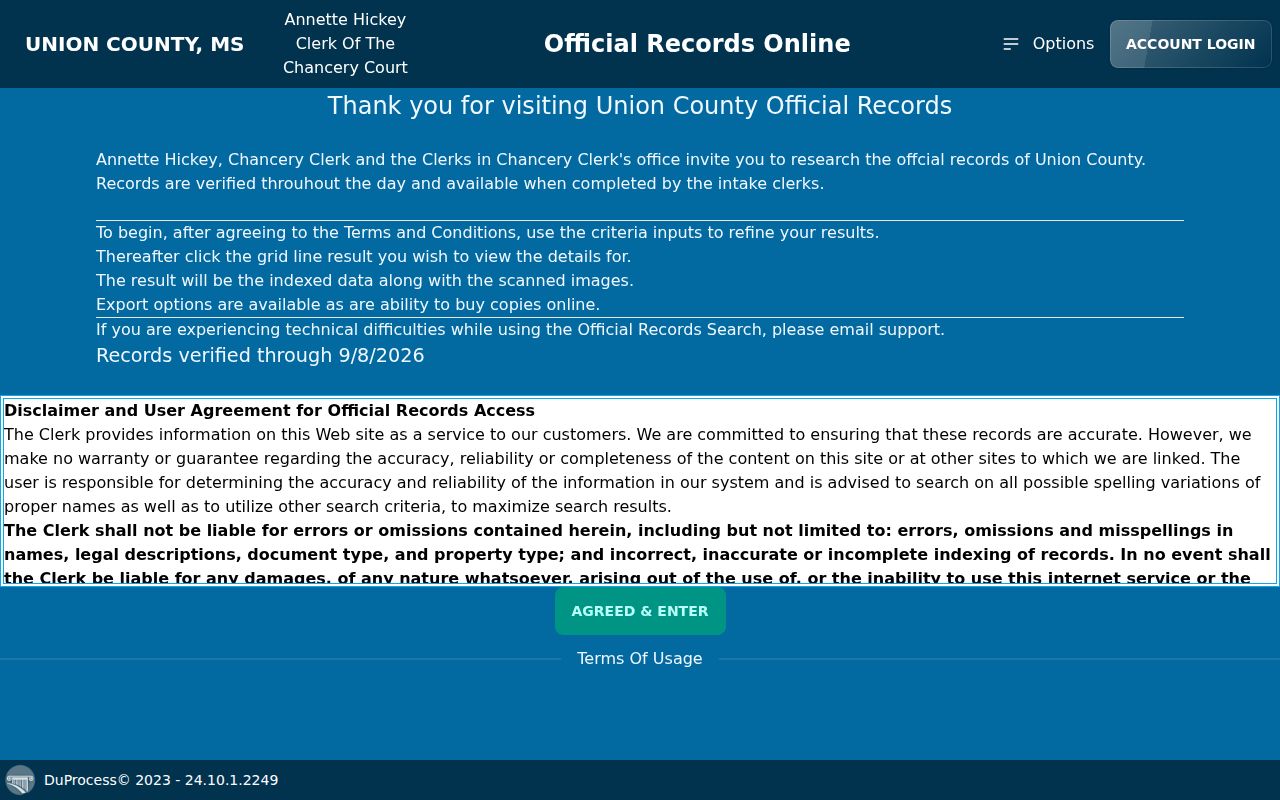
Treat the search surface as a first step. Every deed link you accept still has to line up on three fronts: the named parties, the property description, and the filing chronology. Union County records rarely hand you a clean chain on the first pass, so the worksheet approach pays off.
Build the table as you go. Each row earns its place only when the names, the legal description of the parcel, and the dates all agree with one another. That discipline keeps a Union County property search honest, and it keeps guessed connections out of your deed records.
Note: A shared surname alone proves nothing, since two Union County deeds connect only when the parcel, legal description, date, or prior reference also matches.
Union County's From and To Fields Keep the Chain Moving
The county's inquiry form splits each search into a "From" side and a "To" side, matching the grantor and grantee direction of every transfer. Both directions matter. A previous owner first appears as the buyer, then later shows up as the seller. Run the name each way to keep the Union County property records chain complete. Results can include the instrument number, file date, page count, parcel ID, legal description, parties, and links to the recorded PDF. Start with a narrow date range. Widen it only if the acquisition you expected never surfaces.
- Grantor
- The person or entity conveying an interest.
- Grantee
- The person or entity receiving the stated interest.
- Reverse index
- An index organized to help trace a party in the opposite transaction role.
- Chain of title
- A documented series of instruments affecting the same land, not merely a list of names.
The Union County Clerk recording page covers deeds, mortgages, liens, releases, easements, plats, restrictions, wills, and related instruments. Filter by the transfer type you expect, then inspect nearby entries too, because a Union County parcel may have moved through an estate, a court case, or a delinquent-tax sale rather than an ordinary deed.
Commissioner, Sheriff, and Heir Entries Explain Broken-Looking Histories
Not every Union County transfer reads like a clean sale between two people. A straightforward party search can stall. Kentucky archival guidance suggests turning to index headings like H for heirs, C for commissioner, and S for sheriff. Estate administration, foreclosure, partition, tax proceedings, correction instruments, affidavits of descent, and life-estate language can each reshape history. Each of these can reshape how previous owners appear in the deed records.
When a court-directed deed turns up, note the case or proceeding it grew from. Then go back to the land index for the recorded outcome. An obituary, probate notice, or docket entry may explain a fiduciary signature. It may explain why a fiduciary signed instead of the owner of record. Still, the clue alone proves nothing about who received the parcel. The deed, affidavit, or court order tied to the legal description provides the documentary bridge.
Note: Search institutional names and role words alongside personal names whenever the usual grantor-to-grantee sequence disappears.
Walk the Union County Deed Chain Backward
Treat one confirmed instrument as the hinge for the next search. Keep the legal description exactly as written, because older Union County deeds may rely on acreage, adjoining owners, roads, waterways, lot and block, or metes-and-bounds calls instead of a street address. A consistent parcel clue plus a sensible date sequence beats a familiar surname every time.
- Find the newest deed for the subject land and record its grantee, grantor, date, instrument, and legal description.
- Treat that deed's grantor as the next prior owner, then search that party's earlier acquisition as a grantee.
- Compare parcel, acreage, lot, adjoining-owner, and prior-deed references before accepting the link.
- Repeat until the online evidence ends, then continue from the last book/page reference in deed books, microfilm, and tax rolls.
- Book and page
- A durable citation to a recorded volume and page.
- Instrument number
- The filing identifier used for a recorded document.
- Legal description
- The land description that can survive changes in postal address.
Use 1890 as a Union County Research Turning Point
Think of 1890 as a working turning point for deed research in Union County. Later deeds usually cite the earlier book and page they build on. Before then, the trail is slower. A researcher often has to blend grantor and grantee indexes with yearly tax rolls to pin down the right name. Then go back to the deed books for proof.
That date is a method marker. It is not when the county's records begin. The clerk holds land instruments reaching back to 1811. For a chain that old, ask whether the deed book, index, tax roll, or microfilm you need can be used at the courthouse, through KDLA, or with help from the Union County Public Library. Bring a year range, the names, a land description, and your last solid citation.
Recorded Plats Hold Union County Lot Identity Steady
A plat keeps a former-owner inquiry anchored to the right lot when an early deed carries no modern address. Union County subdivision filings capture the project name, parcel, acreage, lot count, floodplain, zoning, developer, surveyor, and owner fields. The final plat is filed with the County Clerk. Its subdivision name, lot, block, easements, and dedications then become search keys for related deeds.
Use the county GIS map only to orient the present parcel. The recorded plat and the deed records carry the legal record. A map line settles nothing. It does not establish title or fix a boundary. Where land was divided, combined, annexed, or described through an adjoining owner, compare each instrument's land description instead of forcing every past transfer onto today's parcel outline.
Keep the parcel identity stable. Match three clues: the land description or parcel reference, the location or plat, and the parties plus filing date.
Historic Place Names Can Unlock Union County Previous Owners
Old geography gives a searcher aliases that a current address will miss. Uniontown once appeared as Francesburg or Francisburg and Locust Port. Waverly hides a Paynesville clue. Sturgis history runs through Caseyville, the railroad, and coal. These names surface in deeds, probate notices, road descriptions, plats, and tax material. The land may now wear a different mailing label.
Pair a historical term with a surname, executor, administrator, commissioner, plat, road, river, or subdivision. Then verify any promising hit against the Clerk's land instruments. The Kentucky Digital Newspaper Program and local legal notices can surface dates and alternate spellings. Remember the limit, though. A newspaper mention is a lead, not a conveyance.
Note: Keep the original source spelling. Add modern place names as separate search terms rather than rewriting the record.
Choose Online, Counter, or Written Union County Access
DuProcess offers public inquiry tools. eCCLIX gives private citizens five searches per day plus separate paid subscription options. Both web channels work well for locating an instrument. The online holdings do not reach every deed book, however. Confirm coverage before assuming depth. The courthouse remains the practical fallback for deed books, older indexes, microfilm, and copies. Staff there can also guide you on a citation.
A focused written request works too, under the Clerk's open-records procedure. List the names and approximate dates. Include the instrument or book and page if known. Add the legal description, preferred format, and whether inspection would serve the need. Kentucky's Open Records Act sets the framework. The local page describes a written request, a three-working-day determination, advance payment, and copy-fee terms. The Clerk's office can be reached at (270) 389-1334 for current fees.
Know How Far Union County Ownership Records Reach
The County Clerk states that land instruments date to 1811. The searchable web indexes and images may begin later. So do not read "records since 1811" as "every deed since 1811 is online." When a web property search runs dry, carry the last sound citation into the courthouse deed books and KDLA holdings. Earlier land questions may call for patents, tax rolls, surveys, and neighboring conveyances. Label any undocumented break as a gap.
Coverage limit. Union County reports instruments from 1811, but its exact online cutoff is unknown. Older former owners may require deed books, microfilm, tax rolls, and archive help.
A reconstructed list of former owners serves house history and estate work. It also helps with purchase diligence and old easement questions. It is not a certified chain of title. Stop where the evidence stops, and cite each source. Consult a qualified professional whenever legal title is at issue. Public property records must never be used to target a living person.